Space X Data Center Grid Impact
Why the Space X Data Center’s Grid Impact Reaches Beyond Cochise County
At full build-out, the data center campus proposed for Cochise County would need up to 6,000 megawatts of electricity. Running at full power all year, it would use about 2% more electricity than all of Portugal, about 6% more than all of Massachusetts, and about 58% as much as every home and business in Arizona used in 2024. Arizona Attorney General Kris Mayes has described it as “nearly 20 percent of Arizona’s current power-generating capacity.”
Tombstone Resources has applied to build the campus, and SpaceX says it will own and develop it. The power would come through a co-op network connected to the Western Interconnection and the same regional real-time market in which utilities across Arizona trade electricity. If supply gets tight or prices rise, people far outside Cochise County could feel it.
The main points
- The power isn’t lined up. The county is being asked to approve 6,000 megawatts. The wholesale supplier, the Arizona Electric Power Cooperative (AEPCO), has offered only preliminary evidence that it can serve the first 1,500.
- The project would connect to a regional grid and market used by other Arizona utilities. AEPCO supplies co-ops across Arizona and sells power to the pool that serves Pinal County’s electrical districts. It also shares a real-time market with Arizona Public Service (APS), Salt River Project (SRP) and Tucson Electric Power (TEP), as the next section explains.
- The ACC review focuses on co-op customers. It examines the agreement’s effects on AEPCO and participating cooperative customers, not the potential effects on customers of other Arizona utilities.
- Arizona law has no equivalent curtailment requirement for this kind of cooperative customer. Unlike Texas, Arizona does not require a large customer connected to a member-owned cooperative like AEPCO to have equipment and protocols allowing its load to be curtailed during firm load shed.
- The direct financial benefits are not guaranteed. Most would go to co-op members, although the applicant also projects lower transmission costs for AEPCO’s other transmission customers.
Where the power would come from
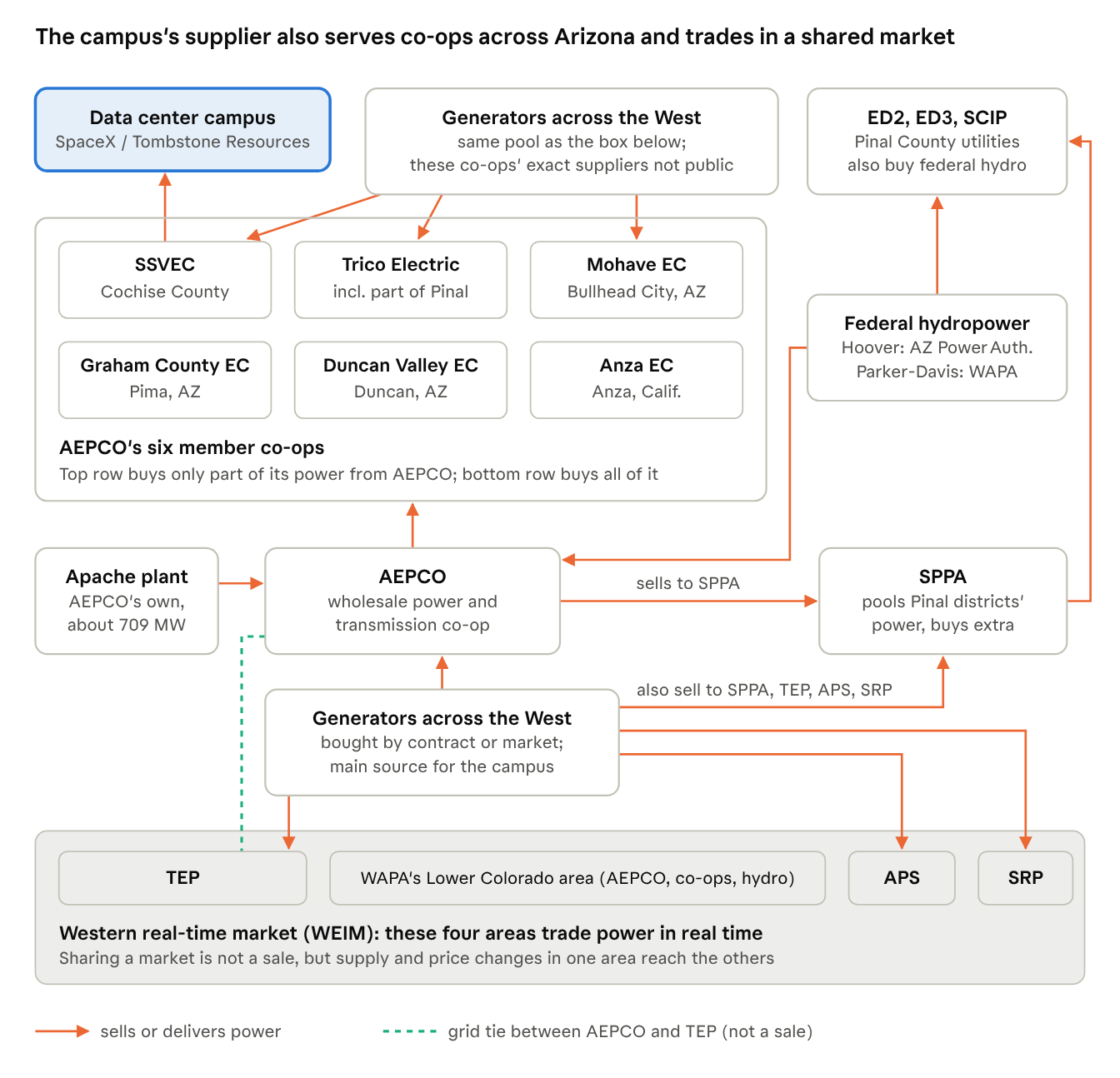
The application names Sulphur Springs Valley Electric Cooperative (SSVEC), the Cochise County electric co-op, as the campus’s retail provider, and AEPCO as its wholesale power and transmission provider. AEPCO’s letter says it would acquire and build the generation and transmission needed, and that later phases would need new facilities. Most of the power would not come from AEPCO’s own plants. The application says AEPCO would serve the campus “principally, through transmission rights and market access that the cooperative has built across the Western Interconnection,” buying “energy from existing generation in neighboring markets that would otherwise sit idle or be curtailed.” APS, SRP, TEP and Pinal County’s utilities buy from that same Western grid.
AEPCO does not serve only SSVEC. It has six member distribution cooperatives: five in Arizona, including Trico Electric, which serves part of Pinal County, and one in California. Three of them, SSVEC, Trico and Mohave, are partial-requirements members, buying a fixed amount of capacity from AEPCO rather than relying on it for all their power. Trico, for example, has told regulators it gets about a quarter of its energy from other wholesale sources, including a contract with Tucson Electric Power. In a planning filing, AEPCO describes its obligation to these co-ops as only to furnish contractually obligated amounts, not to plan for their future growth. Supplying a 6,000-megawatt customer behind SSVEC would be a very different job.
AEPCO also sells power to the Southwest Public Power Agency (SPPA), a pool that manages power for public utilities including Pinal County’s Electrical Districts No. 2 and No. 3 (ED2 and ED3). Both districts also hold federal Hoover Dam power allocations, which Arizona utilities receive through the Arizona Power Authority; ED3 says it separately buys Salt Lake City Area Integrated Projects and Parker-Davis power directly from the Western Area Power Administration (WAPA). The San Carlos Irrigation Project (SCIP), which serves about 13,000 customers in Pinal and neighboring counties, likewise buys power from SPPA and from WAPA, the federal agency that sells hydropower from Hoover and other dams.
One grid, one market
AEPCO and its co-ops sit inside WAPA’s Lower Colorado balancing area, the region WAPA manages to keep power supply and demand in balance. AEPCO’s customers make up nearly 70% of that area’s Arizona load. Since April 2023, that area has traded power in the West’s real-time electricity market, the same market APS and SRP use, along with TEP. AEPCO’s lines also connect to TEP’s grid near Marana.
Being in the same market does not mean these utilities share one pool of power. It does mean that when supply gets tight or prices rise in one place, others can feel it. A large new demand on AEPCO’s system could affect electricity prices or available supply for APS, SRP, TEP and Pinal County’s utilities, even though none of them would serve the campus directly.
The application says AEPCO expects to buy some of the campus’s power from neighboring markets using energy that would otherwise sit idle or be curtailed. Whether that would remain possible at the scale proposed, especially during periods of high demand or constrained transmission, is a question that should be carefully considered.
SSVEC’s own members are already exposed to rising power costs. SSVEC passes what it pays for power through to members without markup, and in May it forecast its power cost charge rising to about 1.5 cents per kilowatt-hour by September and possibly 2 cents by January, which it called a worst-case outlook.
The timing makes this harder. Hoover Dam’s generators are part of the same balancing area, and the Bureau of Reclamation projects that only about 24% of them will be available from April through September 2027, down from 91% in September 2026. The Bureau’s figure is a projection, not a certainty. Meanwhile, APS and SRP reached about 90% of their planned power capacity this summer.
Pinal County’s public utilities rely partly on federal hydropower. When deliveries fall short, for any reason, they have to get more power elsewhere, and their customers pay for it. SCIP has already passed higher power costs on to customers: in May 2024, it added a surcharge of 2.5 cents per kilowatt-hour to cover the cost of the power it buys, and kept it until March 2026.
What the application doesn’t show
The application asks for 6,000 megawatts. AEPCO’s October 29 letter offers only preliminary evidence that the first 1,500 megawatts can be served, and the studies for even that first phase are not finished. The public application does not identify the specific generation resources or power contracts that would supply the remaining 4,500 megawatts. AEPCO and SSVEC both say service depends on future studies, agreements and regulatory approval, and neither guarantees it.
The application’s own concept site plans go further: they label the layouts at 700 megawatts per building, 3,500 megawatts on the AEPCO property and 2,800 on the Southline property, or 6,300 megawatts in all.
Mayes raised the same concern in a November 19 letter asking the county to delay its vote. She said SpaceX has not explained how it would get from 1.5 gigawatts at start-up to 6 gigawatts at full build-out, and she urged the county to review the whole project at once instead of in phases.
Size also matters for grid stability. In 2024, a transmission line fault in Northern Virginia caused about 1,500 megawatts of data centers to switch to backup power at once, a loss grid operators had not anticipated. In July 2026, about 3,800 megawatts did the same, the largest such event in that grid’s history. WECC, which oversees reliability in the West, says new large loads “create reliability challenges that must be addressed immediately.” The application says the campus’s batteries would carry its load through grid disturbances. AEPCO says system studies are under way, but none has been made public showing what would happen to the rest of the grid if a single campus of up to 6,000 megawatts did the same.
Cochise County’s code requires an applicant to show that adequate utility service will be provided without harming existing users. The utility letters do not guarantee service at full build-out. Whether the application as a whole shows that adequate service will be provided without harming existing users remains an open question. The power supply depends on a separate agreement among AEPCO, SSVEC and the applicant, which the Arizona Corporation Commission (ACC) must approve.
The promised benefits
Tombstone Resources and SpaceX have given different numbers for what the campus would do for co-op members. Tombstone’s original October 30 application described those benefits only as under negotiation. A November 1 revision added figures. SpaceX has given larger ones in its project FAQ and at its November 4 community meeting.
| Benefit | Tombstone Resources’ application (Nov. 1) | What SpaceX has said |
|---|---|---|
| SSVEC bill reduction | About $50 to 60 million a year, which SSVEC estimates at roughly 20% | Up to 40% for residential bills |
| Total yearly benefit to SSVEC members | Not totaled | Up to $260 million |
| Yearly benefit to AEPCO members | Patronage capital generated annually, projected at 20% to 90% of AEPCO customers’ current statewide electricity costs (not a guaranteed payment) | Up to $200 million |
| Fee paid to SSVEC | About $150 to 180 million a year | Not stated |
| SSVEC Foundation | About $50 to 60 million a year | Not stated |
All of these numbers are conditional. The application calls them “approximate at full build-out” and “subject to the final [electric service agreement] and to Commission approval,” and SSVEC’s own October 28 letter says the benefits “are not guaranteed.” They would also go only to AEPCO and SSVEC co-op members. Customers of APS, SRP, TEP, ED2, ED3 and SCIP would get little or nothing directly, even though they could feel the effects on prices and supply. Tombstone’s application projects, but does not guarantee, that the transmission upgrades built for the campus would also lower wholesale transmission costs for AEPCO’s other transmission customers, including its member co-ops and the cities of Safford and Thatcher.
The ACC review focuses on co-op customers
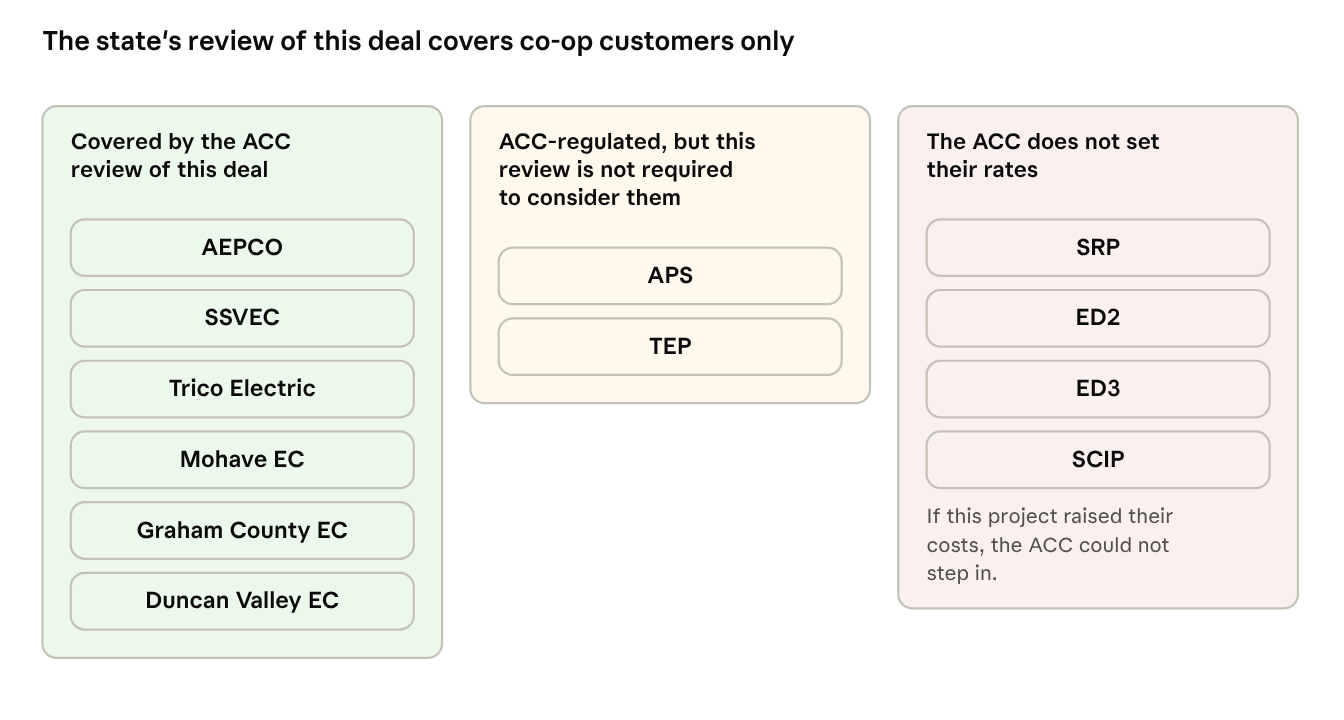
The campus’s power agreement with AEPCO and SSVEC will go through the ACC’s 2026 review process for co-op deals with very large customers, which covers only AEPCO and its participating co-ops. It asks whether the deal is in the public interest, whether rates are reasonable, and whether other co-op customers would end up subsidizing the campus. It asks whether the campus’s power use could be cut back, but does not require that, nor is it required to study how a buyer this size would affect other Arizona utilities or the regional market. Federal regulators, including the Federal Energy Regulatory Commission, oversee wholesale markets in general, but that is not a study of this project.
Most Arizona power customers fall outside the ACC’s review. The ACC regulates APS and TEP, but its review of this deal is not required to look at how it would affect APS and TEP customers. The ACC does not set rates for SRP, ED2, ED3 or SCIP. Its review is not required to consider their customers either, and if this project raised their costs, the ACC could not step in on their behalf.
Arizona’s 2026 law on very large customers, House Bill 2756, lets the ACC require protections in deals with large, round-the-clock customers, such as minimum bills, minimum contract lengths, early-exit terms, security deposits and payments for grid upgrades, so other customers are not left with the costs. But the law exempts member-owned co-ops like AEPCO. For this project, Tombstone’s promise to cover those costs is not yet binding. The terms will be set in an agreement that has not been made public or approved by the ACC.
Texas has also addressed curtailment. It now requires utilities serving large transmission-voltage customers, such as data centers, that connected after December 31, 2025 to develop a protocol, including necessary equipment, to allow the customer’s load to be curtailed during firm load shed, subject to specified exceptions (Texas Utilities Code §39.170). Arizona has no similar rule for co-op customers like this one.
Questions to ask
- What power plants will supply each of the four phases? Which exist today, and which still have to be built or bought?
- Has anyone studied what the full 6,000 megawatts would do to the shared grid, including AEPCO’s tie with TEP near Marana, both normally and when a major line or plant fails?
- Can AEPCO serve the full campus on the hottest summer days with Hoover Dam producing less? Will that analysis be made public?
- Could this campus raise costs for customers of APS, SRP, TEP or Pinal County’s utilities? If so, who pays?
- If hydropower stays low, could ED2, ED3 and SCIP customers face higher costs for replacement power? AEPCO has proposed selling SPPA power from its Apache II solar and battery project. Could the campus’s demand affect that?
- Will the campus agree, in a binding contract, to cut its power use during grid emergencies?
- Will Tombstone’s promise that other customers won’t pay for the campus’s facilities be written into a binding agreement, and will the County see it before voting?
- Southline Transmission LLC owns about 348 acres of the site and is also developing the Southline transmission line to the Apache Substation near Willcox. Will the campus use that line?
How to weigh in
- Written comments: Use the county’s Public Hearing Public Comment Form and choose “SU26-22 191 Data Center and BESS” (BESS means battery energy storage system) under Docket. Comments received by noon on November 27, 2026 go into the commission’s meeting packet. Later comments still become part of the public record. The application is docket SU26-22, filed by Tombstone Resources LLC.
- Hearing: The Planning and Zoning Commission meets December 9, 2026, at 2:00 p.m. in the Board of Supervisors Meeting Room, 1415 Melody Lane, Building G, Bisbee. Virtual participation is available. To speak, submit the county’s Speaker Request Form at least 24 hours ahead. Speakers get two minutes.
This article is based on public documents, including the application, utility letters and state and federal filings, linked throughout so readers can check them. I’m not a utility professional. If you see an error, please let me know and I’ll correct it.